

Lot 400 Warburto Road Moonta Bay SA 5558
For Sale CURRENT BID - see below.
- Property Type Other (Rural)
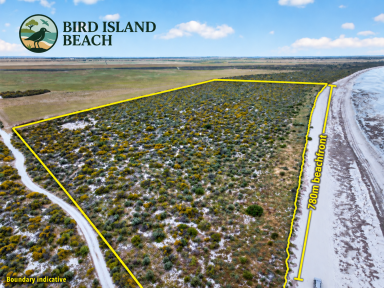
- Land area approx 18.92ha
- Region Yorke and Mid North
- Locality Copper Coast
BIRD ISLAND BEACH - YOUR OWN PRIVATE PATCH OF NATURE
Not every piece of land needs a house on it ..... Sometimes you just want somewhere that's yours.
Somewhere to escape to for the weekend.
Somewhere to camp, explore, watch the wildlife, sit around the campfire when conditions permit, or simply enjoy having your own piece of natural South Australia.
Bird Island Beach is not being offered as a residential building block.
Instead, think of it as your own private nature retreat.
METHOD OF SALE
The property has been conserved by a group of 6 Business and Personal owners for the past 20 years or so.
It's now time to pass the baton to a new owner for conservation.
We are offering the property via Openn Negotiation - Flexible Terms Online Auction.
Unlike a traditional Auction - you can place your bid subject to certain terms and conditions - such as Subject to Finance or Selling a property.
Complete your details on this page to receive the link to further details and bidding site.
Register to bid today - it only takes a couple of minutes.
WHAT COULD YOU DO WITH BIRD ISLAND BEACH?
Bring the tent or camper and enjoy getting away from it all.
Create your own base for weekends on the Yorke Peninsula.
Enjoy the native environment, birdlife, open skies and peace and quiet.
Use it as your own nature reserve - somewhere the family can escape, explore and make memories.
Or perhaps you have an idea for an eco, conservation or nature-based use, subject of course to all necessary council, planning and environmental approvals.
FOR THE BUYER WHO DOESN'T NEED A HOUSE
This isn't about building another home.
It's about owning land - A place you can call your own.
Somewhere to disappear to when you've had enough of traffic, neighbours, phones and the weekly routine.
A place where the entertainment might simply be a chair, a sunset and a sky full of stars.
A DIFFERENT KIND OF PROPERTY
Properties like this won't suit everyone - and that's exactly the point.
If you've been looking for your own patch of nature, a recreational getaway, a conservation project or simply an interesting piece of the Yorke Peninsula to own, Bird Island Beach deserves a closer look.
No house required. Just bring your imagination.
NEXT STEPS
Complete your details on this page to receive further information, photo's and bidder registration details.
About Bird Island Conservation Park
Overview & Purpose
Location: Situated in eastern Spencer Gulf at Warburto Point on Yorke Peninsula, about 10km south of Wallaroo.
Size: Approximately 3.58-3.69km² (358-369ha).
Established: First proclaimed as a fauna conservation reserve on 2 May 1968, re-designated as a Conservation Park in 1972.
Over time, extensions in 1991 included the intertidal zone, and in 1999, a larger mainland section was added.
Managing Authority: Department for Environment & Water, South Australia.
IUCN Category: VI-Managed Resource Protected Area.
WHY IT'S PROTECTED
Primary Objectives:
Conserve seabird breeding habitat.
Protect high-quality mangrove communities and nationally threatened coastal saltmarsh ecosystems.
Also safeguards sensitive environments such as intertidal zones, chenopod shrublands, and foredune systems-vital to habitat for several threatened bird species.
Recognised under international agreements (e.g. JAMBA and CAMBA) for the protection of migratory shorebirds.
Has recorded sites of cultural significance to the Narungga people, reflecting broader conservation of Indigenous heritage.
Habitats & Vegetation
Islands: Edged by grey mangrove (Avicennia marina ssp. marina) woodlands and chenopod shrublands.
Inland, there's coast daisy-bush (Olearia axillaris) shrubland and grasslands (mainly introduced species).
Mainland Section (Warburto Point): Similar composition-sandy beaches, dunes, coast daisy-bush, and Acacia spp. shrublands.
Overall, only nine native plant species have been recorded across the park.
NOTABLE BIRD SPECIES
Migratory Shorebirds (under JAMBA & CAMBA treaties)
Sharp tailed sandpiper
Red knot
Red necked stint
Greater sand plover
Grey tailed tattler
Caspian tern
Terek sandpiper
Birds of Conservation Significance
Cape Barren goose
Lesser sand plover
Pied oystercatcher
Rock parrot
Eastern osprey
Fairy tern
Wider Bird Diversity
Total species recorded: 72 (49 non-passerines, 23 passerines) as of early 2022.
Common species:
Black Swan, Pied Cormorant, Silver Gull, Pacific Gull, Crested Pigeon, Nankeen Kestrel, Singing Honeyeater.
Less common species:
Greater Sand Plover, Grey Plover, Banded Lapwing, Oriental Plover, Little Curlew, Swamp Harrier, Horsfield's Bush Lark.
Park Access & Activities
Access: Via Warburto Road by vehicle; islands reached on foot at low tide or by boat at high tide.
Limited 4WD tracks exist.
Allowed Activities (low-impact only):
Walking along existing trails
Interpretation/education
Scientific research
Nature appreciation
Kayaking
Beach fishing (outside Marine Park Sanctuary Zones)
Threats: 4WD driving on beaches can cause habitat damage. Growing visitor numbers pose management challenges.
Why It's Important
Critical bird habitat - Supports both internationally protected migratory species and regionally significant native species.
Ecosystem diversity - Protects rare coastal and intertidal ecosystems like mangroves and coastal saltmarshes, which are underrepresented across Yorke Peninsula.
Cultural preservation - Contains areas important to Narungga heritage.
Low-impact recreation & science - Balances conservation with opportunities for education, research, and responsible tourism.


Share This Property


Email a friend
You must be logged in and have a verified email address to use this feature.
Call Agent
-
Nigel ChristieUrban & Rural Partners
Call Agent
-
Peta RenshawUrban & Rural Partners